

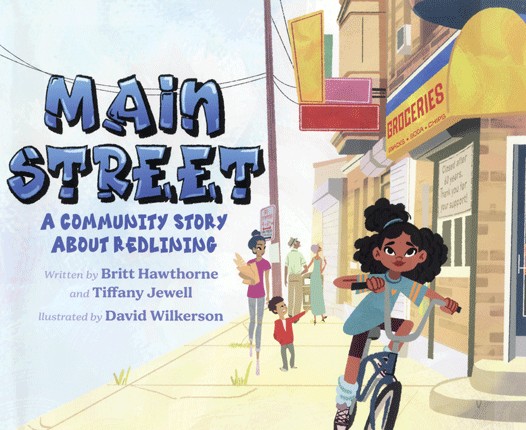
  | Main Street : a community story about redlining Author: Jewell, Tiffany | |
| Price: $23.28 | ||
Summary:
Olivia, a young Black girl, learns about the history of redlining.
| Added Entry - Personal Name: | Hawthorne, Britt |
| Illustrator: | Wilkerson, David |
Reviews:
Kirkus Reviews (11/01/25)
School Library Journal (+) (01/30/26)
Full Text Reviews:
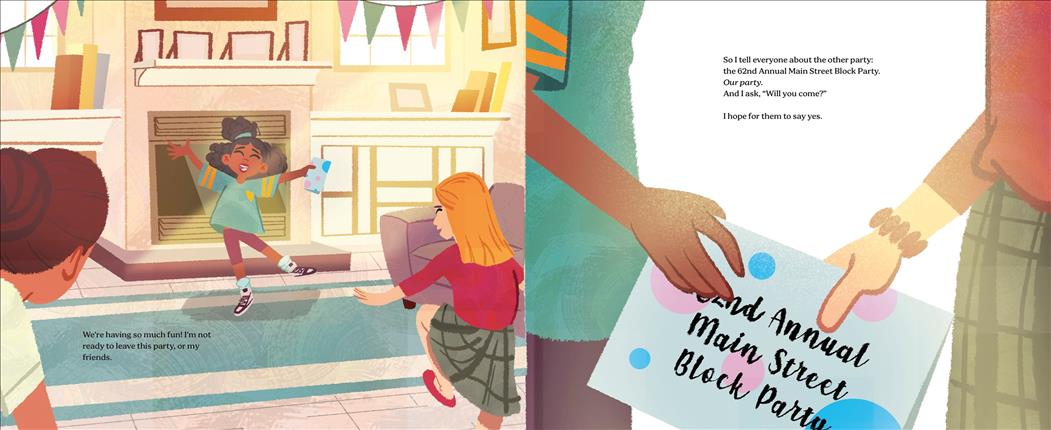
Publishers Weekly - 11/03/2025 Hawthorne and Jewell introduce the concept of redlining in this digestible first-person story of community care. When young Olivia, who reads as Black, invites peers to attend their neighborhood’s annual block party, a pale-skinned friend replies, "I can’t. My mom says Main Street isn’t safe." Unsettled, Olivia chats with elderly neighbor Ms. Effie, who asks to hear more, then shares her own early experiences with having their home derided. A flashback depicts a young brown-skinned family being denied a bank loan, told "It just isn’t a good neighborhood." Noting that "we knew Main Street was just right for our family. It still is," Ms. Effie explains how the family became members of a co-op that approved their loan application, and how the U.S. government’s labeling neighborhoods where Black, brown, and Jewish people lived as "hazardous" denied resources to communities. "Even though the government abandoned us," Ms. Effie says, "we won’t abandon us." Employing gouache brushes and oil paint textures, Wilkerson’s airbrush-like digital illustrations depict a vibrant neighborhood lavished with its residents’ care. Characters are portrayed with various skin tones. An author’s note concludes. Ages 7-10. (Jan.) - Copyright 2025 Publishers Weekly used with permission.
School Library Journal - 01/30/2026 Gr 2–5—Olivia, who has brown skin and textured hair, is told by her light-skinned and light-haired friends that her neighborhood is too unsafe for them to visit (at least according to their parents). Hurt and confused, Oliva exclaims to her dark-skinned, gray-haired neighbor Ms. Effie, "I wish I didn't live here." Ms. Effie explains with love and great detail the history of their Main Street community: how when she was a child during the time her parents were ready to buy a home, banks were drawing red lines around Main Street, while homes in nearby suburbs were given money and support along with blue and green lines. In the absence of government support, families on Main Street formed co-ops and worked together to overcome what obstacles they could, and continue to do so: "Even though the government abandoned us, we won't abandon us." Wilkerson's lively digital illustrations support the text, including examples of maps. Back matter features an author's note and ways readers can support their own communities. While heavy and detailed at times by necessity, this is an excellent jumping-off point for conversations around redlining and further learning. VERDICT A title that tackles describing the discriminatory practice of redlining through narrative with great success, this picture book is recommended wherever fiction highlighting themes of social justice is in demand.—Darla Salva Cruz - Copyright 2026 Publishers Weekly, Library Journal and/or School Library Journal used with permission.
