

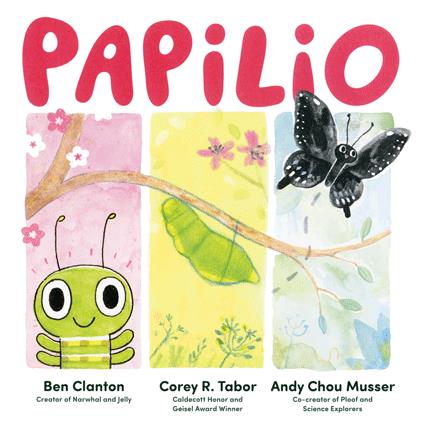
  | Papilio Author: Clanton, Ben | |
| Price: $24.48 | ||
Summary:
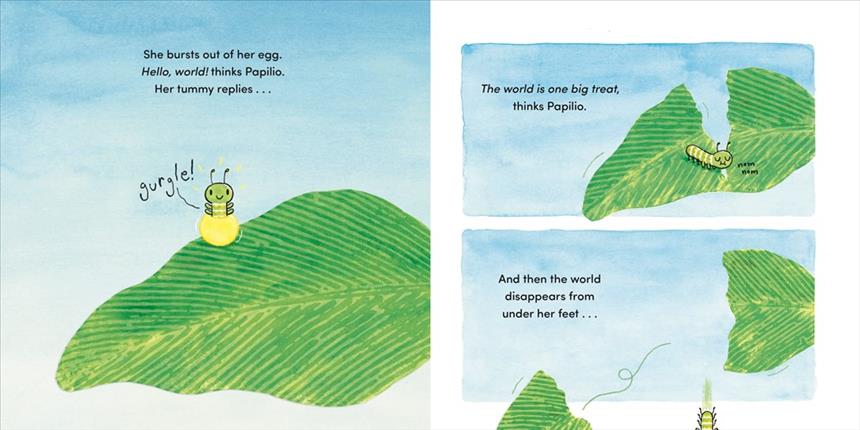
Told in three parts, Papilio transforms from caterpillar to chrysalis to butterfly. She encounters some hiccups as she learns to fly, fall, and feed while avoiding foes and making friends, and most importantly, learns to believe in herself along the way.
| Added Entry - Personal Name: | Tabor, Corey R |
| Musser, Andrew Chou |
| Accelerated Reader Information: Interest Level: LG Reading Level: 2.10 Points: .5 Quiz: 556511 |
Reviews:
Kirkus Reviews (+) (12/01/24)
School Library Journal (03/01/25)
Booklist (02/01/25)
The Bulletin of the Center for Children's Books (00/03/25)
The Hornbook (00/07/25)
Full Text Reviews:
Publishers Weekly - 12/16/2024 Three friends and creators depict the three stages of a black swallowtail’s life-caterpillar, chrysalis, and butterfly-in this playful, punny collaboration. Clanton (the Narwhal and Jelly series), working in mixed media, introduces protagonist Papilio (Papilio polyxenes) as a yellow egg who hatches into a wide eyed-and, yes, mighty hungry-green caterpillar. Papilio soon tumbles off a leaf into an overwhelming world where a friendly mouse helps her devour a red, ripe strawberry. In the book’s second section, Caldecott Honoree Tabor portrays the chrysalis stage using pencil, colored pencil, and watercolor. With Papilio now turned into "goo" in a green pod ("You can’t become a butterfly without first becoming caterpillar soup"), two hapless robins eye the shell before the mouse again intervenes. Finally, Chou Musser (the Ploof series, with Clanton) presents Papilio’s debut as a butterfly facing new challenges: flying is difficult, and predators lurk. But she finally takes flight and, in a sweet turnabout, lends a hand to the mouse. With a light narrative and visual touch, the creators’ sections are just different enough to convey a sense of growth, optimism, and change. Facts and a creators’ note conclude. Ages 3-7. (Mar.) - Copyright 2024 Publishers Weekly used with permission.
School Library Journal - 03/01/2025 PreS-K—Papilio, which means butterfly in Latin, is a collaborative story written by three authors in three chapters. "Caterpillar" is about a caterpillar who eats her way out of her egg, through the leaf that supports her, and into a chance meeting with a mouse. "Chrysalis" features the same caterpillar in chrysalis-form. Although she's snug and safe, and actively transforming, the chrysalis is passed roughly among hungry birds, dropped to the ground, and ultimately lands in the arms of the mouse from the first chapter. "Butterfly" is about the emerging butterfly, who learns to fly, escapes frogs and a spider, and is finally reunited with her mouse friend. The book accurately explains the life cycle of the butterfly and may be useful in a science classroom or unit study. The narrative perspective and style vary from author to author, resulting in a very complex narrative experience. Some children may need an assist from an older reader to understand what's happening, as well as the science behind the story. Use of difficult science terms, puns, and colloquialisms frequently make the story less accessible, though scientifically compelling. A note at the end explains the collaborative process by which the book was written. VERDICT An ambitious attempt to explain the life cycle of a butterfly to readers who are acquiring literacy.—Benjamin Ludwig - Copyright 2025 Publishers Weekly, Library Journal and/or School Library Journal used with permission.
Booklist - 02/01/2025 Three friends wrote a three-part story about three stages of a butterfly’s life, and the result is a charming tale with nods to the science of it all. Though each section reflects the sensibilities of its author, the story line of friendship and navigating change flows smoothly throughout. Narwhal and Jelly fans will gleefully recognize Papilio’s fondness for puns in Clanton’s depiction of a newly hatched caterpillar who gets a boost from a mouse. Meanwhile, the emotional journey as Papilio figures out her butterfly wings and repays the mouse’s favor will resonate with fans of Musser’s other work. The true standout is Tabor’s playful interaction of words and images while Papilio is “caterpillar soup” in her chrysalis. In the text, Papilio imagines herself safe and dreams of adventures; the illustrations reveal her being thrown about, almost eaten, then rescued by her friend. Readers writing reports on insect life cycles will want to look elsewhere, but this good-natured, funny fictional framing is sure to be a hit with those who already have a handle on the basics. - Copyright 2025 Booklist.
