

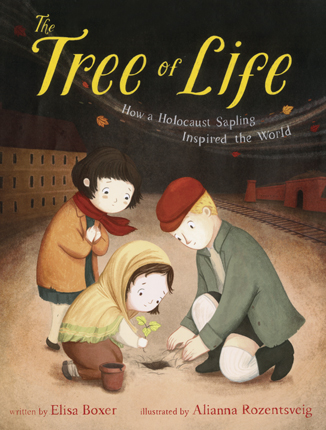
  | Tree of life : how a Holocaust sapling inspired the world Author: Boxer, Elisa | |
| Price: $23.78 | ||
Summary:
During World War Two, in the concentration camp Terezin, a group of Jewish children and their teacher planted and nurtured a smuggled-in sapling. Over time there were fewer children left to keep lovingly sharing their water with it. When the war ended the sapling had grown to a strong maple. Nearly eighty years later the tree's 600 descendants around the world are thriving, including one planted at New York City's Museum of Jewish Heritage in 2021.
| Illustrator: | Rozentsveig, Alianna |
| Accelerated Reader Information: Interest Level: LG Reading Level: 4.00 Points: .5 Quiz: 553506 |
Reviews:
Kirkus Reviews (11/15/23)
School Library Journal (01/26/24)
Booklist (01/17/24)
The Bulletin of the Center for Children's Books (+) (00/12/23)
Full Text Reviews:
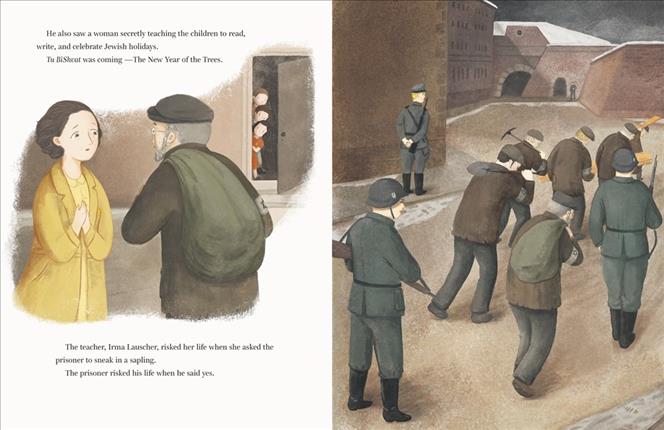
School Library Journal - 01/26/2024 K-Gr 4—Boxer and Rozentsveig provide a story of hope in this book, focusing on the life and legacy of a maple tree planted in secret by Irma Lauscher, a Jewish teacher, and students in Terezin (located in modern-day Czech Republic). Miraculously, both the teacher and the tree survive the Holocaust and WWII. Subsequently, seeds from the tree are planted around the world; those trees are still thriving today, despite the original "dropping its last leaf" in 2007. The difficult subject matter feels more approachable both through the narrative's language and accompanying soft illustrations. A sparingly used, intense red indicates the Nazis' presence and amplifies with a jolt the otherwise earth-toned artwork. After the narrative, an author's note provides additional information about the descendants of the original tree, the teacher, and the location itself. Selected sources are also included. Front end papers feature fall-colored foliage on a black background, while in the back, bright spring colors evoke hope and a new day. VERDICT An approachable and valuable resource. Recommended for most collections.—Taylor Worley - Copyright 2024 Publishers Weekly, Library Journal and/or School Library Journal used with permission.
Booklist - 01/17/2024 Commemorating a living Holocaust memorial, Boxer tells how a seedling maple smuggled into the Terezin camp in a sympathizer’s shoe was planted in celebration of Tu BiShvat (“The New Year of the Trees”), nurtured for years by imprisoned children, and survived the war. The children’s teacher and others went on to distribute the tree’s seeds and cuttings to many places. Though the original tree died in 2007, its progeny will continue to grow and be symbols of survival that, as the author puts it, “honor the past and nourish the future—for generations to come.” In Rozentsveig’s solemn illustrations, bright-eyed children first gather around a tiny stick in the dirt to marvel and share a few drops of their carefully rationed water before being taken to Auschwitz, and then in final urban scenes they witness workers planting a young tree and later sit in its shade as their teacher reads a story. That the tree-based religious holiday has taken on environmental overtones in recent times adds a further layer of interest to this ongoing act of remembrance. - Copyright 2024 Booklist.
