

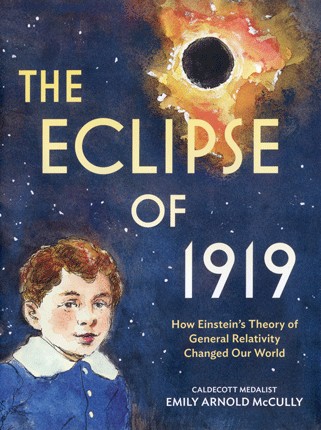
  | Eclipse of 1919 : how Einstein's Theory of General Relativity changed our world Author: McCully, Emily Arnold | |
| Price: $23.28 | ||
Summary:
An awe-inspiring picture book biography about Albert Einstein and the story of how he proved his Theory of Relativity during the 1919 solar eclipse.
Reviews:
School Library Journal (+) (05/01/25)
Booklist (06/01/25)
The Hornbook (00/07/25)
Full Text Reviews:
School Library Journal - 05/01/2025 Gr 1–5—McCully brings her signature delicate illustrations in a combination of pen-and-ink and watercolors to convey Albert Einstein's path to proving his theory of relativity—that all the elements of universe are relational. Her broad strokes cover Einstein's early life, including his lackluster academic beginnings, through his initial wonderings about stars, and attempts to photograph and document movement of stars during an eclipse. World War I made his plan impossible in 1914, but during the total eclipse of 1919, he was finally able to prove his theory. Blending rigorous research, scientific explanation, and the backdrop of war, this tale is unique in its attention to her subject's missteps and experimental failures along the journey to worldwide acclaim. Balancing watercolor-laden vignettes and white space with several striking spreads (including a dramatic two-page depiction of the eclipse's total darkness), the art dances with movement and life, capturing Einstein's energy and his quirkiness while adding a lighthearted counterpart to the detailed text. Back matter includes a rich bibliography, author's note, and explanation of an eclipse. VERDICT A rigorously researched addition to the body of biographies about Einstein, and ideal for upper elementary students.—Rebecca Kirshenbaum - Copyright 2025 Publishers Weekly, Library Journal and/or School Library Journal used with permission.
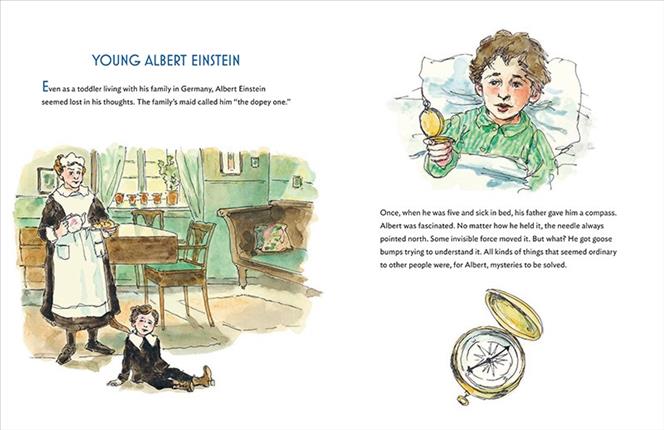
Booklist - 06/01/2025 Growing up in a German household, Albert Einstein loved figuring out how things work. Even as a toddler, he was so often lost in thought that the maid called him “the dopey one.” Later, his imagination and “thought experiments” led him to discover new ways of understanding forces such as gravity. Isaac Newton had developed his theories some 200 years earlier, but Einstein enjoyed seeking his own answers. When his theory of relativity was first published during WWI, it was largely ignored. But after he found a way to test the theory using photographs taken during a solar eclipse, the images supported his ideas and led to his reputation as a genius. This picture book’s prologue briefly introduces Newtonian physics and how Einstein’s “wild ideas” challenged widely accepted views. The appended “Sources” section includes books and other resources that may be helpful to teachers introducing Einstein or eclipses to children. The concise text introduces biographical and scientific information, while McCully’s distinctive ink-and-watercolor pictures beautifully illustrate the people, their actions, and the period settings. - Copyright 2025 Booklist.
