

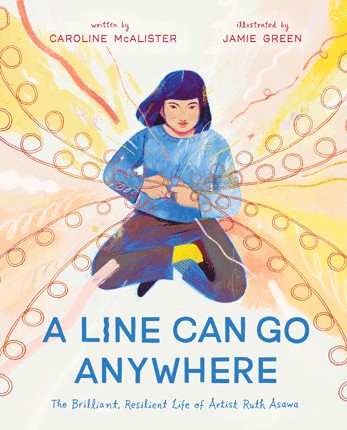
  | Line can go anywhere : the brilliant, resilient life of artist Ruth Asawa Author: McAlister, Caroline | |
| Price: $24.48 | ||
Summary:
A picture book biography about influential Japanese-American sculptor Aiko Ruth Asawa and her childhood spent in an incarceration camp during WWII.
| Illustrator: | Green, Jamie |
Reviews:
Kirkus Reviews (+) (01/15/25)
School Library Journal (03/28/25)
Booklist (+) (12/01/25)
The Bulletin of the Center for Children's Books (+) (00/01/25)
The Hornbook (+) (00/05/25)
Full Text Reviews:
School Library Journal - 03/28/2025 Gr 1–4—A line is a lovely metaphor for a biography of Ruth Asawa. Her life is divided by lines—the line between being Japanese and American at a particularly difficult time in U.S. history. There is the line of the beautiful hills of California where she was born, the line of barbed wire across the fences where she was imprisoned with her family and other people of Japanese descent during WWII, and the line of racism she encountered. Yet she persisted in creating art in any way she could, through drawing, painting, and sculpture, using line and form to inspire and entertain people of all ages, telling people, "Art is for everyone." She also worked toward developing art education programs in San Francisco and beyond. The inspiring artwork mirrors some of the shapes in Asawa's work, and the use of some vivid colors in the mostly muted palette makes the message pop. The book has themes of finding one's voice, racism, persistence, and finding beauty in the world. VERDICT A first choice for any library seeking books about history, inspirational women or artists, and social justice.—Debbie Tanner - Copyright 2025 Publishers Weekly, Library Journal and/or School Library Journal used with permission.
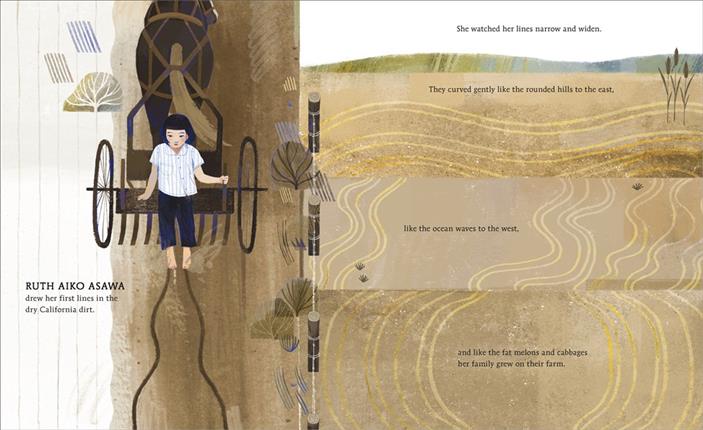
Booklist - 02/01/2025 *Starred Review* Lines can fence things in. They can lead out and away. This picture-book biography shows how lines did both for American modernist wire sculptor Ruth Aiko Asawa, whose art grew out of being imprisoned as a girl in U.S. incarceration camps during WWII. Both text and illustrations (created using charcoal and watercolor) emphasize lines, both literal and metaphorical. Asawa, one of seven children, grew up on a vegetable farm in California. The first illustration is of her sitting on a horse cart, dragging her toes in the dirt to make lines. We learn that Asawa and her family, as Japanese Americans, must toe an invisible line, being Japanese at home and acting “American” in school and in public. After Pearl Harbor, Ruth’s family is imprisoned, first crowded into horse stalls at a racetrack and then sent to a brutal relocation center in Arkansas, surrounded by barbed wire. Two imprisoned Disney animators in the first camp teach Ruth to draw. Later, she uses her fascination with lines to shape the wire sculptures that are now exhibited worldwide in museums and in San Francisco public spaces. This unblinking and timely look at racism is also an inspiring, thought-provoking story. - Copyright 2025 Booklist.
