

  | There's no such thing as vegetables Author: Lukoff, Kyle | |
| Price: $23.78 | ||
Summary:
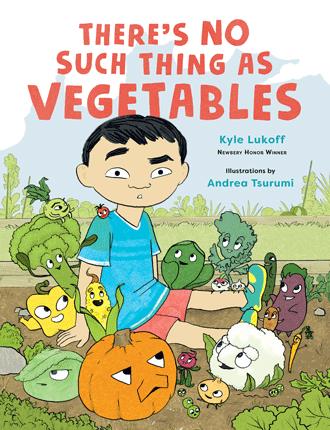
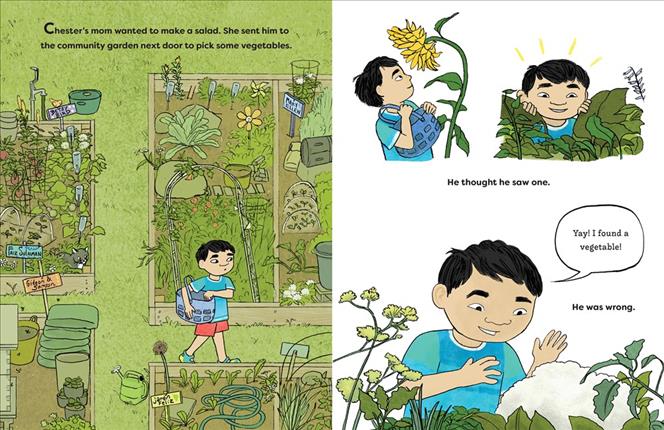
Chester plans to have a salad for lunch, but in order to do that, he'll need vegetables. So, he goes to the community garden, except he quickly learns that he won't be dressing a salad anytime soon. Instead, the vegetables start dressing him down. According to them, "vegetables" don't exist!
| Illustrator: | Tsurumi, Andrea |
| Accelerated Reader Information: Interest Level: LG Reading Level: 2.50 Points: .5 Quiz: 553784 |
Reviews:
Kirkus Reviews (12/01/23)
School Library Journal (00/03/24)
Booklist (02/01/24)
The Bulletin of the Center for Children's Books (00/01/24)
Full Text Reviews:
School Library Journal - 03/01/2024 Gr 1–3—Chester's mom wants him to get some vegetables from the community garden for a salad. This turns out to be a tricky task when each so-called vegetable he finds is sassy and unhelpful, explaining why it is not what he is seeking. Eggplant is a fruit, carrot and potato are roots, kale is a leaf, broccoli is a flower. Finally, the kale breaks it to him—there is no such thing as a vegetable. After hearing about the jobs of the fruits, flowers, roots, and leaves, not to mention how angry the beet is at having its sugar content questioned, a defeated Chester asks, "If there is no such thing as vegetables, why do people call you vegetables?" The crux of the book arrives at last. The foodstuffs question the reality of human-made categories: money, countries, states, language—and vegetables. Mind blown, Chester tells them he's going to have a sandwich for lunch instead of a salad. On the final page there is Lukoff's thought-provoking note about social constructs surrounding categories. Tsurumi's excellent illustrations give Chester and the myriad vegetables individual personalities, including some wonderfully amusing facial expressions. Her use of movement, perspective, color, and white space help move the mash-up of game-changing facts plugged awkwardly into cartoon-style storytelling forward. The almost exclusive use of speech balloons occasionally crowds the page, simply because there are so many speaking parts, but it is successful overall. The humans depicted have a variety of skin tones. VERDICT The mixed bag doesn't diminish the intriguing ideas, despite the somewhat forced format.—Catherine Callegari - Copyright 2024 Publishers Weekly, Library Journal and/or School Library Journal used with permission.
Booklist - 02/01/2024 Chester’s mom sends him to the community garden to pick vegetables for a salad, but he has a difficult time because all the plants inform him that there’s no such thing as vegetables. Broccoli and Artichoke are flowers, after all; Potato is a root; Kale is a leaf; Eggplant and Cucumber are fruits. They further argue their merits—they attract pollinators, gather sunlight, and transport oxygen—until Chester eventually cedes their point and forgoes salad for a sandwich. Tsurumi’s hand-drawn and digitally colored illustrations give distinct personalities to each plant, making lettuce look emo and celery look sleepy with equal adeptness. The story is straightforward and makes some scientific and salient (if a bit dry) points. Most uniquely, the book highlights some things that are rarely found in picture books, both in illustration (kohlrabi, chard, and parsnip) and in concept (how language creates categories, an aside on semantic satiation, and back matter on the dangers of social constructs). Though heavy-handed, this book can be appreciated for its representation of a diverse community-garden experience. - Copyright 2024 Booklist.
