

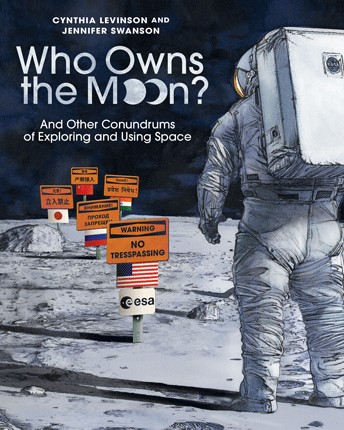
   | Who owns the moon? : and other conundrums of exploring and using space Author: Levinson, Cynthia | |
| Price: $26.58 | ||
Summary:
Are you ready for your first trip to the moon? This book is a primer on what to know for a future in space. It combines technology and science with law and policy for a fascinating look at a very timely subject.
| Added Entry - Personal Name: | Swanson, Jennifer |
Reviews:
Kirkus Reviews (+) (11/01/24)
School Library Journal (02/14/25)
Booklist (+) (12/01/25)
The Hornbook (00/05/25)
Full Text Reviews:
Publishers Weekly - 10/14/2024 What happens if a country leaves debris in Earth’s orbit? Can countries claim pieces of outer space? Levinson (Free to Learn) and Swanson (Up Periscope!) answer these questions and more in this approachable work about the ethical and political challenges surrounding cosmic exploration. Beginning with the early days of the space race, the creators discuss the United Nations’ passing of the 1967 Outer Space Treaty-formally known as the Treaty on Principles Governing the Activities of States in the Exploration and Use of Outer Space, including the Moon and Other Celestial Bodies-which introduced myriad laws regarding the cosmos that became the foundation for contemporary accords. Some such agreements include the prohibiting of nuclear weapons in space and the Moon Treaty, which declared the moon "the common heritage" of humankind. Sparse text details how countries sought legal ways to control not just the ownership of space but the behavior conducted and conflict occurring there as well. Photographs, scientific graphics, and factual insets abound in this simplified depiction of complex topics that encourages readers to ask their own questions about international space travel and, perhaps, pursue answers while forging intergalactic careers themselves. Ages 12-up. (Jan.) - Copyright 2024 Publishers Weekly used with permission.
School Library Journal - 02/14/2025 Gr 7–10—From the first lunar landing to modern satellite innovations, this book captures the exploration and occupation of space. It delves into the partnerships and conflicts between nations that have made space travel possible and complicated. Chapters about the recent rekindled fascination with the Moon and future space missions will have readers dreaming of the possibilities and their ability to participate. Details about satellites and space treaties will drive readers further into the narrative. Levinson and Swanson write with such excitement and expertise that space enthusiasts and students with obligatory nonfiction reading projects will find themselves captivated. While the book is text-heavy, which is appropriate for the target audience, color photos and drawings are scattered throughout and each chapter begins with a striking two-page color background image. The book concludes with photo credits, extensive source notes, further readings, a detailed bibliography, and a thorough index, making this not only an interesting read but a useful source for research. VERDICT A highly recommended addition to all YA nonfiction collections.—Kate Rao - Copyright 2025 Publishers Weekly, Library Journal and/or School Library Journal used with permission.
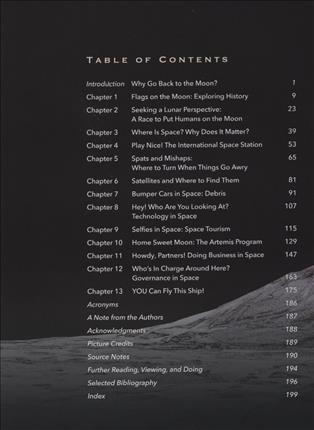
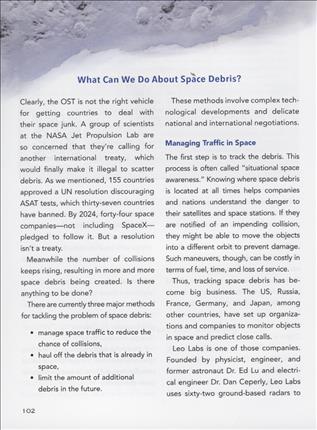
Booklist - 11/01/2024 *Starred Review* As NASA prepares to return humans to the moon with the Artemis program, Levinson and Swanson consider philosophical debates with extreme consequences well beyond the scientific logistics of traveling through space. In a comprehensive, direct, and engaging manner, the authors begin with the Space Race but diverge from most space books by concentrating on the Outer Space Treaty (OST), which forms the basis of international space law. However, established in 1967, the OST does not consider modern dilemmas of working and living on the moon. Systematic chapters that build on one another take readers through the science of Earth’s atmospheric layers, the International Space Station, satellites, debris (aka “space junk”), space tourism, and more while also encouraging them to think about possible problematic outcomes. For instance, the OST is binding among countries, but what about private companies? No one can own the moon, but what about its natural resources? The integration of recent global events, like the high-altitude Chinese balloon over U.S. airspace, makes this book a timely and informative effort. A cumulative chapter dedicated to governance in space uses “sticky scenarios” with fictional astronauts from competing countries to guide readers to their own opinions. The authors conclude on a positive note with a roundup of space-related careers besides astronaut, such as opportunities in fashion, food chemistry, economics, and law. - Copyright 2024 Booklist.
