

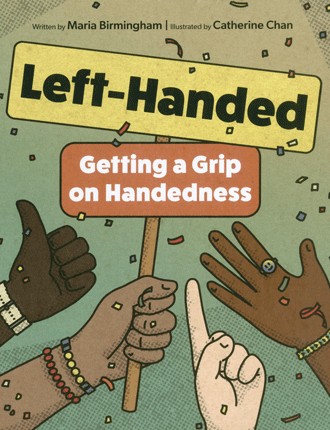
  | Left-handed : getting a grip on handedness Author: Birmingham, Maria | |
| Price: $23.96 | ||
Summary:
It examines all things lefty from handedness in our ancient ancestors to lefty myths to current theories about the roles of genetics, environment, and brain structure. It also tackles intriguing questions: Why and when does someone become a lefty? Are humans the only left-handed animals? And what is it like to live a left-handed life in a right-handed world?
| Illustrator: | Chan, Catherine |
Reviews:
Kirkus Reviews (01/15/26)
School Library Journal (+) (01/01/26)
Booklist (01/01/26)
Full Text Reviews:
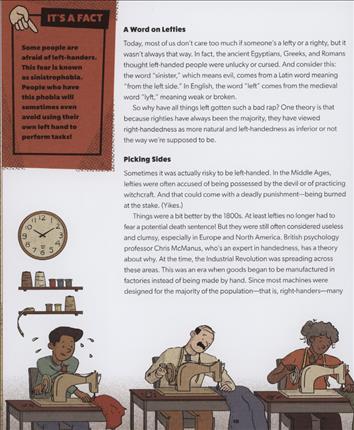
School Library Journal - 01/01/2026 Gr 4–5—This comprehensive nonfiction title explores left-handedness from myriad angles, including sports, genetics, animal behavior, and weird scientific studies. Copious text is highly readable and rich with intriguing details. The content will appeal to a wide range of readers. Aspiring archaeologists will learn about theories of prehistoric handedness based on cave-painting analysis. Budding grammarians will appreciate vocabulary lessons, such as how the word "left" comes from the Old English lyft, meaning "weak or broken." The book's design is attractive and engaging. Fun facts are featured in bite-sized sidebars, such as a quiz that asks readers which hand they use for various activities, like using a spoon or brushing their hair; handedness isn't just about writing. Chan frequently uses illustrations that span two pages or stretch across vertical margins, skillfully drawing the eye across the page. Her sophisticated art employs elegant lines and an earthy palette. Human faces are as expressive as they are simple, and a wide variety of skin tones are displayed. Both men and women are shown at work and play, sewing and playing sports. Animals like dogs, cats, and even snails are rendered with the same care. Back matter includes an index and selected sources. While handedness may be less stigmatizing today, the book demonstrates human adaptation through the ages and promotes an acceptance of our differences. VERDICT A fascinating and beautifully designed exploration of an under-examined topic. A must-have for all collections.—Chance Lee Joyner - Copyright 2026 Publishers Weekly, Library Journal and/or School Library Journal used with permission.
Booklist - 01/01/2026 Why are some people right-handed and others left-handed? Is this a trait passed from parents to their children? Worldwide, are more people lefties or righties? Do certain countries have significantly more of one group or the other? These are a few of the questions addressed in this well-researched, engaging volume. Birmingham, who identifies herself as a leftie, takes an evenhanded approach, pointing out that although she writes with her left hand, her right hand takes over when she needs to use scissors. In researching the book’s topic, she came across research on people in prehistoric times. Based on their interpretations and conclusions after studying bits of teeth, cave drawings, and the design of hand tools, they estimated that probably 80% of the cave dwellers were right-handed and 20% left-handed. Birmingham plays down the advantages of being right-handed or left-handed, though she notes that in some sports, lefties excel. With interesting ideas and handsome illustrations on every double-page spread, here’s an intriguing book for lefties and righties alike. - Copyright 2026 Booklist.
