

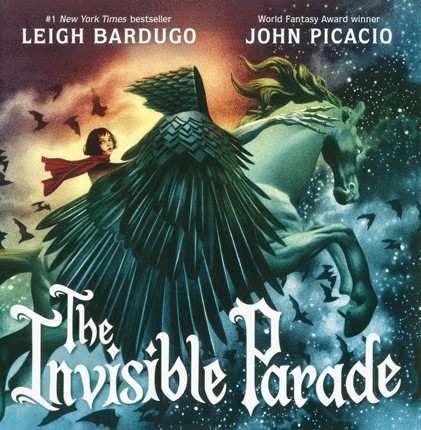
  | Invisible parade Author: Bardugo, Leigh | |
| Price: $23.98 | ||
Summary:
A young girl examines fear and death and discovers bravery against the backdrop of Dia de Los Muertos.
| Illustrator: | Picacio, John |
| Accelerated Reader Information: Interest Level: LG Reading Level: 3.90 Points: .5 Quiz: 558540 |
Reviews:
Kirkus Reviews (+) (06/15/25)
School Library Journal (06/01/25)
Booklist (+) (12/01/25)
Full Text Reviews:
School Library Journal - 06/01/2025 Gr 2–5—A heartfelt journey through grief, memory, and celebration. Centered on young Cala, the story unfolds during the Day of the Dead as she grapples with the recent loss of her grandfather. What begins as a somber walk through her family's offerings and traditions transforms into a magical and emotional voyage, guided by four symbolic horsemen. Each encounter offers Cala a profound moral lesson—not just about death, but about what it means to live, to feel, and to remember. Bardugo weaves family ritual, food, and decor into a narrative that highlights the essential role of community and tradition in the healing process. The use of motifs such as skeletons lends authenticity and beauty to Cala's inner and outer worlds, reinforcing the message that celebration and sorrow are often entwined. Illustrations elevate the story further. With richly saturated colors (so much so in some scenes that text readability may be a challenge for newer readers) and expressive detail, the artwork captures the complexity of Cala's emotions, from loneliness to connection. Shadows and bursts of color visually echo her transformation, emphasizing that while grief can feel isolating, love and memory tether us to the living and the departed alike. VERDICT A touching and visually stunning picture book that honors the depth of loss while celebrating the enduring power of family, tradition, and remembrance.—Jessica Calaway - Copyright 2025 Publishers Weekly, Library Journal and/or School Library Journal used with permission.
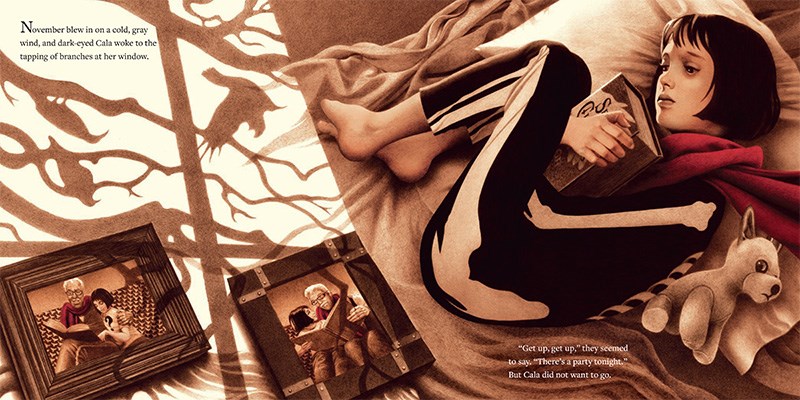
Publishers Weekly - 06/09/2025 Bardugo and Picacio collaborate on a stirring story of personal and familial observance in this sweeping work. As young Cara’s family readies for the D?a de los Muertos celebration, the girl feels deep grief about the death of her grandfather, whose scarlet scarf she wears over a skeleton suit. While the family prepares by cooking, picking up loaves of orange-scented bread and bunches of marigolds, and building an ofrenda, Cara cannot help but lament. Upon entering the cemetery, she becomes lost, encountering four elaborately depicted horsemen, each of which stands for a specific concept. The fourth, Death, shows Cara a magnificent "invisible parade"-the living and dead joyfully mingling-and explains both that "I am nothing to fear" and that her ancestors are with her still. Truly captivating graphite-rendered artwork layers in cultural cues while moving from sepia to saturated jewel tones, and intentionally paced, chapter-book-like narration plumbs moving connections between grieving and rejoicing. Characters are portrayed with various skin tones. Creator notes conclude. Ages 5-9. (Aug.) - Copyright 2025 Publishers Weekly used with permission.
Booklist - 07/01/2025 *Starred Review* Cala is in no mood for celebration. Without her grandfather, she’s downtrodden, moving from task to task “fast, fast, eyes on the ground.” As she moves about the festive day, she encounters distinct moments—colliding with an ill woman and returning her handkerchief, her mama offering coins to a hungry homeless person, her siblings arguing over painted sugar skulls and Grandfather’s favorite songs, and her papa’s ofrenda assembly. That evening, a distracted Cala observes others celebrating Día de los Muertos and is accidentally separated from her family. Alone and concerned, she happens upon a spirit—a sickly skeleton atop a slimy horse—who helps start her journey back to her family. Three more horsemen appear to her (a hungry, bony rider; a grumpy, argumentative rider; and a quiet, contemplative rider), and each speaks to the events of the day, noting that they are always around but serve a greater purpose than the discourse they cause. Cala recognizes the last rider as Death, the proprietor of the evening festivities, and as Death guides her back, she reflects on her own grief and finds gratitude for the riders and the role they play. Distinct, colorful graphite spreads and spirited gatefolds present the cultural pieces of the celebration with dignity and love, and Cala’s charming skeleton jumpsuit and red scarf (inherited from Grandfather) help distinguish her throughout detailed pages. Bardugo and Picacio have crafted an understated masterclass in processing grief through culture. - Copyright 2025 Booklist.
